-
Latex Resistance Bands
Regular price $59.97Regular priceUnit price per$79.97saleSale price $59.97Sale -
Latex Resistance Bands
Regular price $59.97Regular priceUnit price per$79.97saleSale price $59.97Sale -
Latex Resistance Bands
Regular price $39.97Regular priceUnit price per$59.97saleSale price $39.97Sale -
Latex Resistance Bands
Regular price $39.97Regular priceUnit price per$59.97saleSale price $39.97Sale -
Latex Resistance Bands
Regular price $99.97Regular priceUnit price per$129.97saleSale price $99.97Sale -
Latex Resistance Bands
Regular price $99.97Regular priceUnit price per$129.97saleSale price $99.97Sale

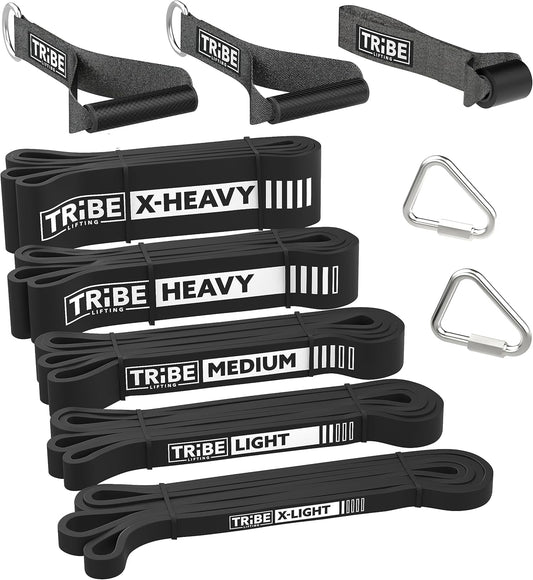


Long Resistance Bands for Full-Body Workouts
Tribe Lifting long resistance bands are made for strength training, stretching, mobility, warm-ups, and compact home gym workouts.
Use the natural latex loop bands on their own for squats, rows, presses, deadlifts, banded push-ups, shoulder work, and assisted bodyweight exercises. Add handles and a door anchor when you want more cable-style movements, or choose a workout bar set for exercises that feel closer to barbell and gym-machine training.
Start with lighter resistance for warm-ups, mobility, arms, and shoulders, then move to heavier bands for legs, back, chest, and stronger full-body movements.
Not sure which long loop band setup fits your training? Explore resistance levels and learn how to use the bands on their own, with handles, or with a workout bar in our how to use long loop resistance bands guide.

5 resistance levels
Choose from X-Light to X-Heavy bands for warm-ups, mobility, strength work, and full-body training.

Natural latex stretch
Long latex loops provide smooth, progressive resistance that gets stronger as the band stretches.

Build your setup
Start with bands only or choose sets with handles, a door anchor, attachment hooks, and a workout bar.

Train anywhere
Use them at home, in the gym, while traveling, or with a door anchor, pull-up bar, or band bar.
What are long loop resistance bands best used for? +
Long loop resistance bands are best used for full-body strength training, stretching, mobility, warm-ups, and home workouts. Use them for rows, presses, squats, deadlifts, banded push-ups, shoulder work, core exercises, and assisted bodyweight movements.
What is the difference between bands only, handles, and bar sets? +
Choose bands only if you want simple latex loop bands for strength work, stretching, and mobility. Choose the handles and door anchor set if you want more upper-body exercises like rows, presses, curls, and triceps work. Choose the workout bar set if you want a more complete resistance band setup for bar-style squats, presses, rows, curls, and full-body workouts.
Are these the same as pull-up assistance bands? +
No. These are long latex loop bands and resistance band sets made for full-body training, stretching, mobility, and home workouts. They can be used for assisted pull-ups, but the dedicated pull-up assistance system has an adjustable height strap, padded foot support, and stackable bands made specifically for pull-up and chin-up progression.
How do I choose the right resistance level? +
Use lighter bands for warm-ups, mobility, stretching, shoulders, arms, and controlled rehab-style movements. Use medium bands for rows, presses, and general strength work. Use heavy or X-Heavy bands for legs, back, chest, and stronger full-body movements. The right band should make the last few reps challenging without breaking your form.
What exercises can I do with long resistance bands? +
You can use long resistance bands for rows, chest presses, overhead presses, bicep curls, triceps extensions, squats, deadlifts, banded push-ups, face pulls, pull-aparts, stretching, and mobility drills. With a door anchor, handles, or workout bar, you can create more exercise angles.
What is the difference between loop bands and tube bands? +
Loop bands are continuous latex loops that work well for stretching, mobility, strength training, and bodyweight assistance. Tube bands usually have handles and clips, making them better for cable-style exercises like chest presses, rows, curls, and triceps work.
Can I use these bands at home without much space? +
Yes. Long resistance bands are compact and work well for small home gyms, apartments, travel workouts, and warm-ups. You can use them on their own, under your feet, around a sturdy anchor point, with a door anchor, or with a compatible workout bar.
How should I care for long latex resistance bands? +
Store the bands in a cool, dry place away from direct sunlight, heat, moisture, and sharp edges. Wipe them with a damp cloth when needed, let them dry fully before storage, and inspect them before use. Replace any band that shows cracks, tears, thinning, or damage.